 |
|
|||||||||


|
Why
does the noise level change & what causes the noise ? |
|
| Scientists track solar cycles
by counting sunspots -- cool planet-sized areas on the Sun where intense
magnetic loops poke through the star's visible surface. Hathaway is
an expert forecaster of sunspot numbers. "Sunspot counts peaked
in 2000 some months earlier than we expected," he recalls. The
subsequent dip toward solar minimum seemed premature to Hathaway,
and indeed it was. Before long, sunspot counts reversed course and
began to climb toward a second maximum that now appears to be only
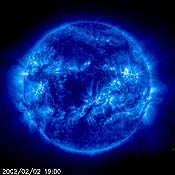
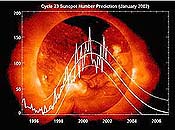
a few percent smaller than the first. Solar Max eleven years ago was much the same. A first peak arrived in mid-1989 followed by a smaller maximum in early 1991. In fact, if the ongoing cycle proves to be a double, it will be the third such double-peaked cycle in a row. The last two sunspot cycles also had double-featured maxima. During solar maximum, magnetic fields above the Sun's surface become impressively tangled, particularly near sunspots. Twisted magnetic fields -- stretched like taut rubber bands -- can snap back and explode, powering solar flares and coronal mass ejections. Sunspots are the most visible sign of those complex magnetic fields -- but not the only one. Another sign is solar radio emissions, which come from hot gas trapped in magnetic loops. "The radio Sun is even brighter now than it was in 2000," says Hathaway. By the radio standard, this second peak is larger than the first. Hathaway notes a widespread misconception that solar activity varies every 11 years "like a pure sinusoid." In fact, he says, solar activity is chaotic; there is more than one period. Earth-directed solar explosions, for instance, tend to happen every 27 days -- the time it takes for sunspots to rotate once around the Sun. There is also an occasional 155-day cycle of solar flares. No one knows what causes it. And the double peaks of recent solar maxima are separated by approximately 18 months. |
|
 |
|
| Contact Us | About US | Servicing your Equipment | Warranty | Payment Methods | Shipping Cost |  |
|
| Site Map | Privacy & security | Payment acceptance | Order fulfillment | Order cancellations | Exchange & Refund |
| Our Blog | Video Index | Testimonials | Servicing Your Equipment |
Social Sharing |